The Persian Puzzle
Understanding Iran, Its History, and America’s Conflict with a Nation
How did the United States and Iran become enemies? Why does Iran harbor such profound distrust of the West? And how have decisions made decades—or even centuries—ago brought us to the dangerous confrontation we face today?
To understand America’s current conflict with Iran, we must first understand Iran itself: its extraordinary history, its people, its religion, and its deeply rooted determination to remain independent of foreign powers.
In this compelling four-part lecture series, David Bisno takes us on a remarkable journey through more than 2,500 years of Persian history, revealing how ancient civilizations, religious divisions, imperial ambitions, political betrayals, and catastrophic miscalculations have shaped the modern Middle East.
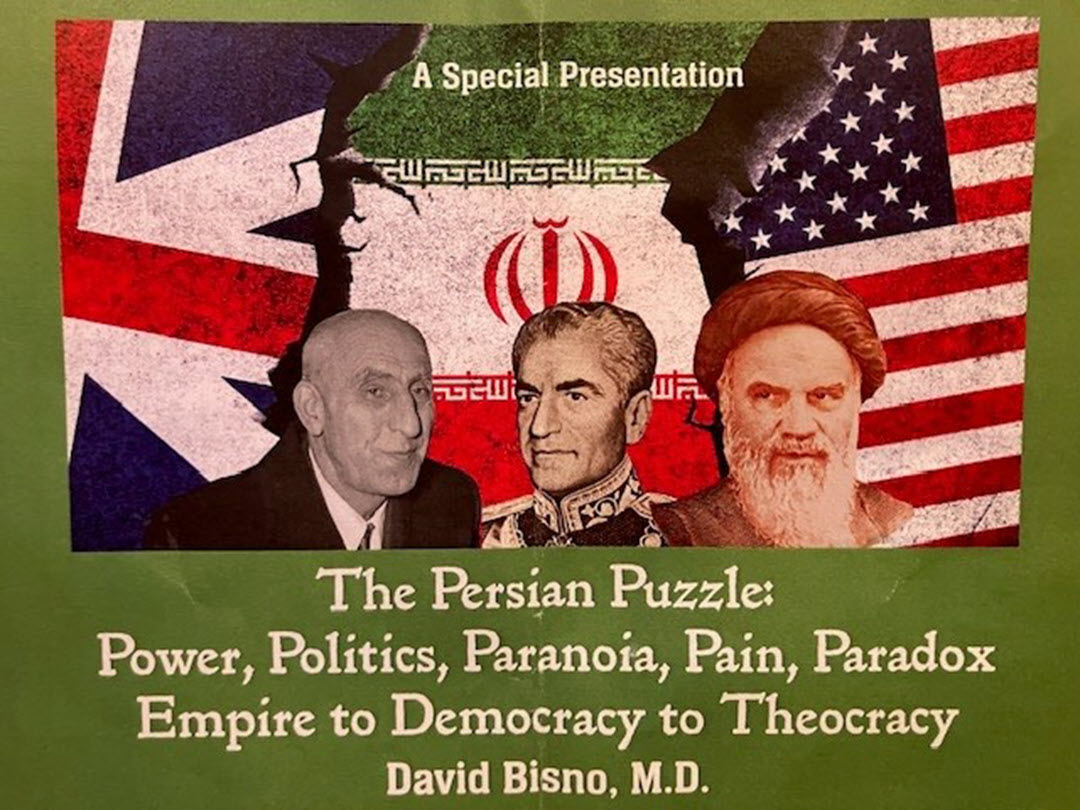
The story begins with Persia’s astonishing ability to preserve its identity despite centuries of foreign conquest. It moves through the rise of Shia Islam, the corruption of successive shahs, and Britain’s exploitation of Iranian oil. It examines one of the most consequential—and often overlooked—events in American foreign policy: the 1953 CIA- and British-backed overthrow of Iranian Prime Minister Mohammad Mossadegh, whose efforts to establish national sovereignty and constitutional government threatened Western interests.
From there, the series explores the Shah’s increasingly authoritarian rule, the Islamic Revolution of 1979, the American hostage crisis, the devastating Iran-Iraq War, and the unintended consequences of subsequent American military interventions.
Throughout these presentations, David Bisno draws upon the timeless wisdom of William Shakespeare to illuminate recurring patterns of political arrogance, ambition, betrayal, incompetence, and the tragic consequences of leaders who misunderstand the people they govern.
This is not simply a history of Iran. It examines how we arrived at one of the most dangerous international confrontations of our time.
At a moment when American military actions, Iranian resistance, regional instability, and the threat of wider war dominate the headlines, these four lectures provide essential historical context largely absent from everyday political debate.
Understanding Iran’s actions does not require approving of its government, its repression, or its foreign policies. But understanding the historical experiences that shape Iranian attitudes toward the United States is indispensable to making informed judgments about our own country’s decisions.
The central lesson of The Persian Puzzle is both illuminating and unsettling: **The consequences of political decisions rarely end when those who made them leave office. Some endure for generations, shaping conflicts that their architects could never have imagined.**
Before deciding what America should do about Iran, we owe it to ourselves to understand how we got here.
How did the United States and Iran become enemies? Why does Iran harbor such profound distrust of the West? And how have decisions made decades—or even centuries—ago brought us to the dangerous confrontation we face today?
To understand America’s current conflict with Iran, we must first understand Iran itself: its extraordinary history, its people, its religion, and its deeply rooted determination to remain independent of foreign powers.
In this compelling four-part lecture series, David Bisno takes us on a remarkable journey through more than 2,500 years of Persian history, revealing how ancient civilizations, religious divisions, imperial ambitions, political betrayals, and catastrophic miscalculations have shaped the modern Middle East.
The story begins with Persia’s astonishing ability to preserve its identity despite centuries of foreign conquest. It moves through the rise of Shia Islam, the corruption of successive shahs, and Britain’s exploitation of Iranian oil. It examines one of the most consequential—and often overlooked—events in American foreign policy: the 1953 CIA- and British-backed overthrow of Iranian Prime Minister Mohammad Mossadegh, whose efforts to establish national sovereignty and constitutional government threatened Western interests.
From there, the series explores the Shah’s increasingly authoritarian rule, the Islamic Revolution of 1979, the American hostage crisis, the devastating Iran-Iraq War, and the unintended consequences of subsequent American military interventions.
Throughout these presentations, Bisno draws upon the timeless wisdom of William Shakespeare to illuminate recurring patterns of political arrogance, ambition, betrayal, incompetence, and the tragic consequences of leaders who misunderstand the people they govern.
This is not simply a history of Iran. It examines how we arrived at one of the most dangerous international confrontations of our time.
At a moment when American military actions, Iranian resistance, regional instability, and the threat of wider war dominate the headlines, these four lectures provide essential historical context largely absent from everyday political debate.
Understanding Iran’s actions does not require approving of its government, its repression, or its foreign policies. But understanding the historical experiences that shape Iranian attitudes toward the United States is indispensable to making informed judgments about our own country’s decisions.
The central lesson of The Persian Puzzle is both illuminating and unsettling: The consequences of political decisions rarely end when those who made them leave office. Some endure for generations, shaping conflicts that their architects could never have imagined.
Before deciding what America should do about Iran, we owe it to ourselves to understand how we got here.
The Persian Puzzle — Understanding Iran’s Remarkable History
How can we understand modern Iran without understanding the civilization that shaped it? In this opening lecture, David Bisno takes viewers on a fascinating journey through 2,500 years of Persian history, exploring ancient empires, religious transformations, and repeated foreign invasions. Discover the origins of Zoroastrianism, the historical division between Sunni and Shia Islam, and the extraordinary resilience of Persian culture. Drawing connections to Shakespeare’s timeless insights into power and human nature, Bisno establishes the historical foundation for understanding today’s tensions between Iran and the West. His central revelation is compelling: Empires conquered Persia repeatedly, but Persian civilization endured.
The Persian Puzzle — The Shahs, British Imperialism, and the Battle for Persian Oil
How did a once-powerful civilization lose control of its own destiny? In this second lecture, David Bisno explores Persia’s turbulent transformation from 1796 to 1941, revealing how corrupt shahs, British and Russian imperial ambitions, and the discovery of oil reshaped the nation. From the Constitutional Revolution of 1906 to Winston Churchill’s determination to secure Persian oil for Britain’s navy, Bisno traces decisions whose consequences still resonate today. Drawing on Shakespeare’s insights into power, greed, and political folly, he reveals how foreign exploitation and failed leadership fueled resentment, undermined democracy, and laid the groundwork for modern Iran’s troubled relationship with the West.
The Persian Puzzle — The 1953 Coup, the Shah, and the Road to Revolution
How did American intervention help transform Iran from a promising democracy into an Islamic theocracy? In this revealing third lecture, David Bisno examines the 1953 CIA-backed overthrow of Prime Minister Mohammad Mossadegh, the restoration of Shah Mohammad Reza Pahlavi, and the unintended consequences of Western foreign policy. From the Shah’s ambitious modernization programs and brutal secret police to Ayatollah Khomeini’s revolutionary rise, Bisno traces the miscalculations that culminated in the 1979 Iranian Revolution and American hostage crisis. Drawing on Shakespeare’s insights into power and political blindness, he reveals how decisions made decades ago continue to haunt U.S.–Iran relations today.
The Persian Puzzle — The Islamic Revolution and Iran’s Confrontation with the West
Why has Iran remained so deeply distrustful of the United States? In this concluding lecture, David Bisno traces the consequences of Iran’s 1979 Islamic Revolution through decades of warfare, foreign intervention, and political upheaval. From Saddam Hussein’s invasion of Iran and the Iran-Contra scandal to America’s invasion of Iraq and Iran’s expanding military influence, David Bisno reveals how unintended consequences have reshaped the Middle East. Featuring a firsthand account of life in Iran under religious rule, the lecture explores the enduring struggle between national independence, authoritarian power, and Western intervention—and challenges viewers to reconsider the origins of today’s dangerous confrontation.